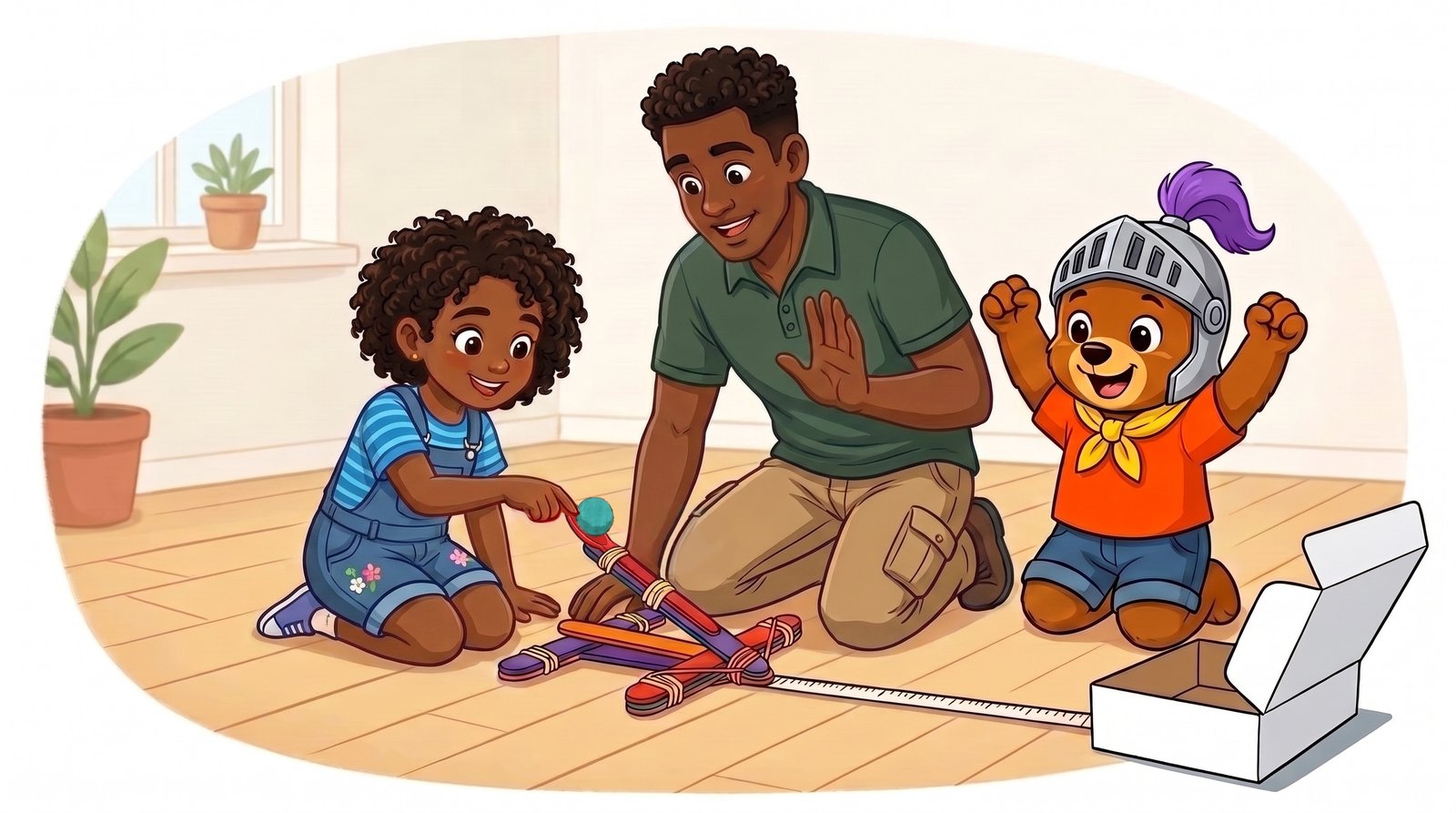
What your child will learn
Four big ideas, discovered by launching rather than by being told.
- How bending and stretching can store energy
- How a lever and its fulcrum fling things
- How launch direction changes a flight
- How to run a fair test and use your data to win
What's in the box
Everything your child needs, except six thin books from a shelf.
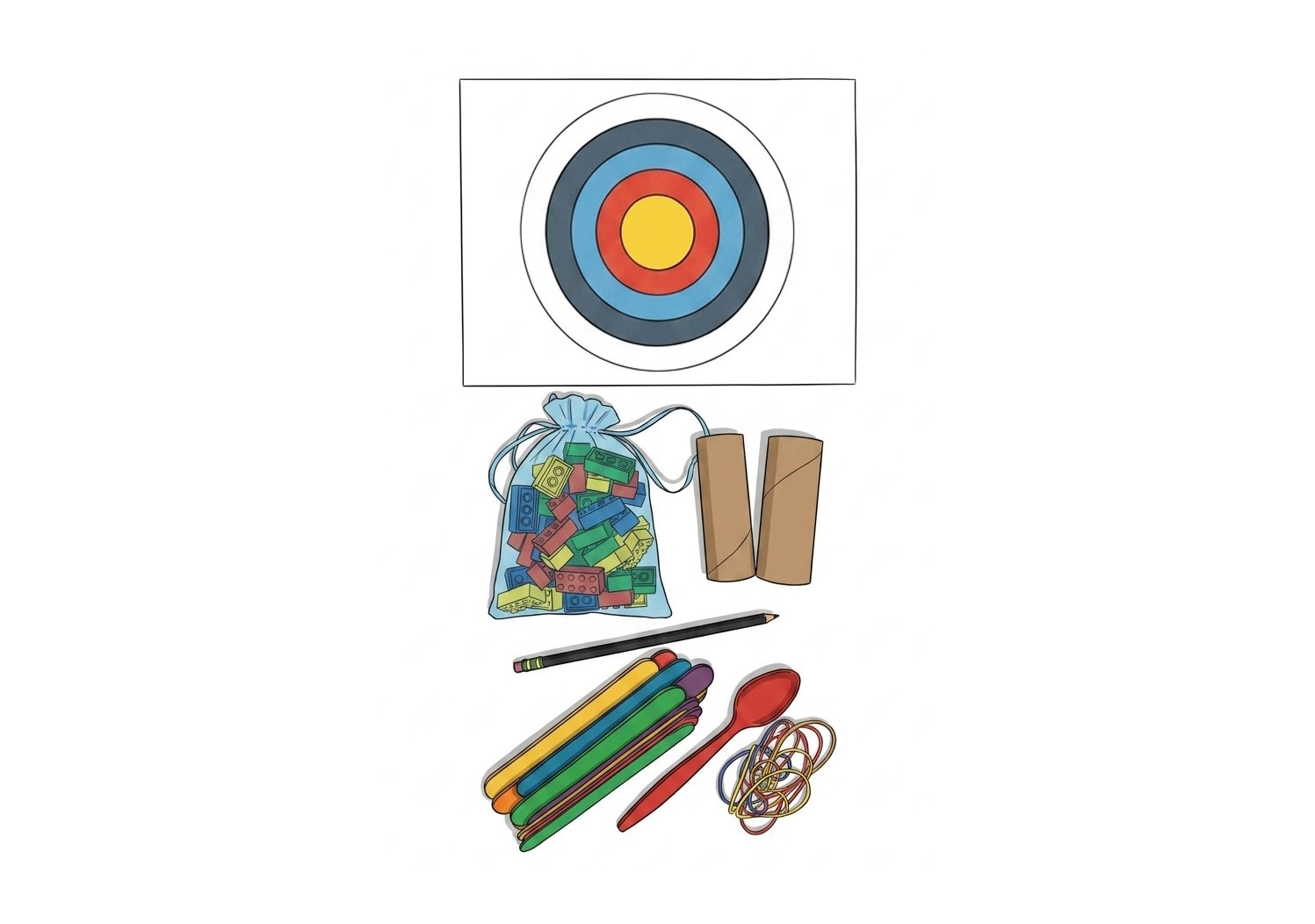
- Craft sticks and rubber bands — for the catapult
- A plastic spoon — the catapult's launch arm
- Two cardboard tubes and a pencil — the slingshot
- 5 felt balls — the only things you'll ever launch
- A bullseye target
- Building bricks and target design cards — for the Grand Challenge
- A tape measure
- Your workbook
- The companion guide, for the grown-up helping
You'll also need six thin books from home — they tilt the catapult in Activity 3.
What you'll do, section by section
Seven short videos are on the way — one for each part of the workbook. Until then, here is the path the workbook takes.
| Section | Workbook pages | What happens |
|---|---|---|
| Start Here | Workbook pagespp 2–4 | What happensMeet Bolt, check the box, and read the Safe Launch rules. |
| Activity 1: Fling the Catapult | Workbook pagespp 5–10 | What happensBuild the catapult. Add sticks to the stack and watch the distance climb. |
| Activity 2: Pull Back & Sling | Workbook pagespp 11–14 | What happensBuild the slingshot. Pull to Short, Medium, and Full — and measure. |
| Launchers Through History | Workbook pagespp 15–17 | What happensBows, buckets, rubber balls, and war machines. Same problem, different machines. |
| Activity 3: Angle Test | Workbook pagespp 18–21 | What happensSame push, new direction. Tilt the catapult on books and see what changes. |
| Science Spotlight: Stored Energy | Workbook pagespp 22–24 | What happensStored energy, moving energy, and the two teams behind every launch. |
| Grand Challenge: Siege the Fort! | Workbook pagespp 25–29 | What happensTune both launchers with your data. Box Shot, then Breach the Wall. |
Videos coming soon. The workbook and companion guide are ready today.
Have the books at home
Both books are free to download and print.
The workbook leads the way
Your child builds, launches, measures, and writes down what they find. No science background is needed to help — the companion guide gives you the questions to ask.